
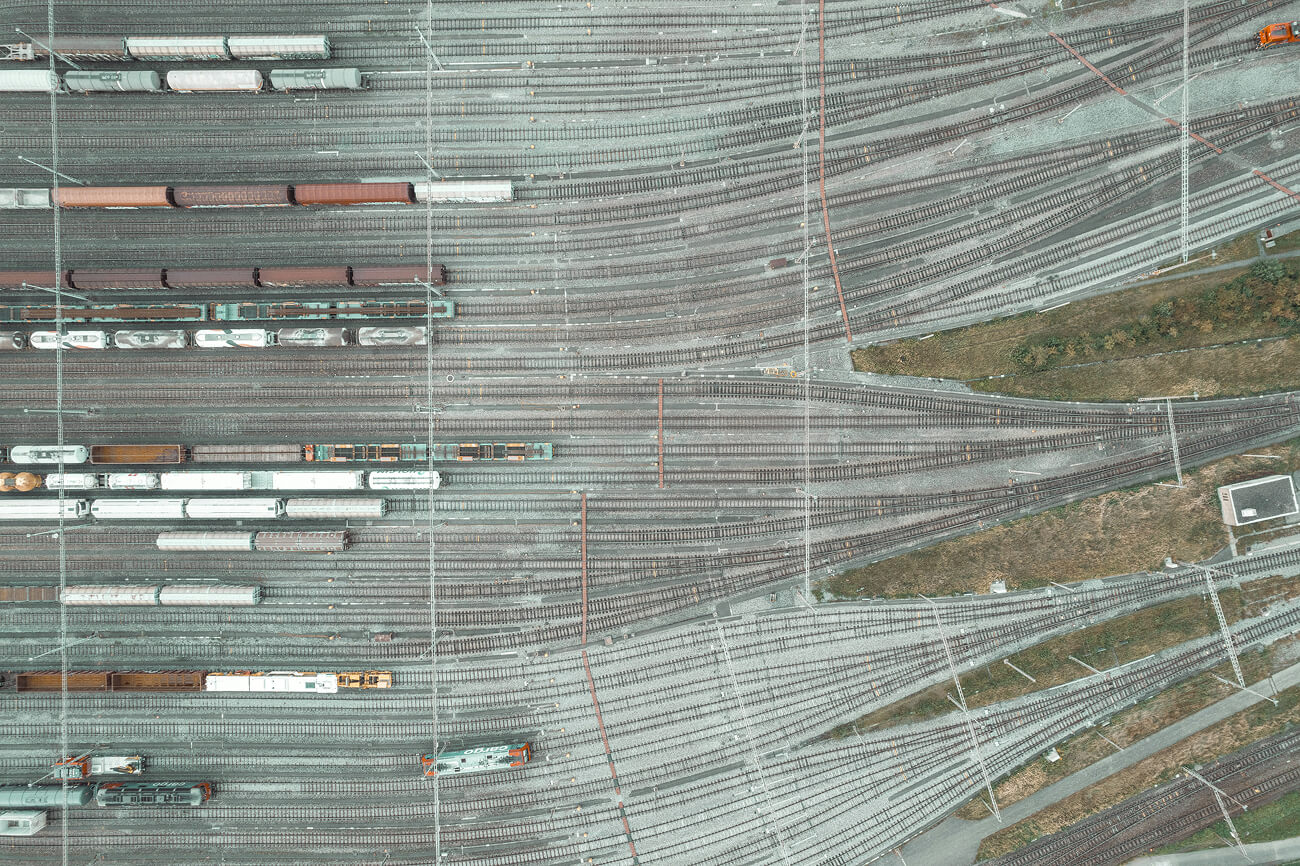
Rail throughput without infrastructure investment sounds like wishful thinking. In practice, it is an optimization problem — and most freight networks are nowhere near solving it.
Every year, railway operators invest capital in the most visible answer to a capacity problem: more track, more locomotives, more rolling stock. These decisions are rational. But they often solve the wrong problem.
The real capacity constraint on most freight rail networks is not infrastructure. It is not fleet size. It is the gap between the capacity that already exists and the capacity that operators actually use.
Most national rail networks face a situation where demand for existing infrastructure capacity exceeds supply. Yet academic research and field data consistently show that the same corridors — with the same locomotives and the same sidings — can move significantly more trains per day when sequencing decisions are made optimally rather than manually.
The difference between a network running at 60% of installed capacity and one running at 90% is not a construction budget. It is a planning and execution problem. And it has a technology solution.
This article explains where the capacity gap comes from, what throughput optimization looks like in practice, and how intelligent movement planning systems recover trains-per-day without adding a single kilometer of track.
To understand why throughput optimization works, start with the physics of single-track freight operations — the dominant configuration on freight-heavy networks in developing markets, mining corridors, and private industrial railways worldwide.
On a single-track corridor, trains traveling in opposite directions must exchange at designated passing loops — sidings long enough for one train to clear the main line while the opposing train passes. The order and timing of these exchanges — the crossing sequence — determines everything: transit times, network throughput, and the total trains moved per period.
Here is the critical insight: the crossing sequence is a combinatorial optimization problem. A network with dozens of trains — each with different origins, destinations, priorities, and running times — produces an astronomically large number of possible sequences. The globally optimal one, the sequence that minimizes total transit time across all trains simultaneously, cannot emerge from a human dispatcher working with a paper train graph.
What human dispatchers produce under operational pressure is a locally reasonable sequence. Each individual decision seems sensible in isolation. Together, they compound into suboptimal aggregate outcomes. Trains wait longer than necessary. High-priority consists sit behind lower-priority ones. A conflict at one siding ripples into delays at the next three.
Infrastructure managers typically lack the software-based simulation capabilities needed to predict demand for infrastructure capacity accurately and resolve conflicts in real time. The result is a network that looks congested when it is actually underutilized — not because the infrastructure cannot handle more trains, but because sequencing decisions fail to extract the available capacity.
Throughput optimization operates across three distinct planning horizons. Each has different levers and different consequences for network performance.
The first and most underused opportunity is at the strategic level — before any infrastructure decision.
Most capacity analyses in freight rail start from an assumption: “we need more trains per day, therefore we need more sidings, more track, or more locomotives.” This logic leads directly to capital expenditure. But the question that precedes it — how much capacity does the existing infrastructure actually have under optimal sequencing? — rarely gets a rigorous quantitative answer.
Strategic capacity simulation changes that. By modeling the current network with an optimization engine rather than a spreadsheet, operators can determine with precision what throughput the existing infrastructure supports. This analysis frequently reveals that the required throughput is achievable within existing assets. Alternatively, it shows that targeted, minimal investment — a siding extension here, a loop relocation there — unlocks far more capacity than general track expansion at a fraction of the cost.
By using data to maximize existing infrastructure, rail operators can add services or reduce delays without expensive new construction. The simulation establishes the baseline — what the network can do — against which any investment proposal should then be evaluated.
The second horizon is timetable generation. A poorly constructed timetable is the most persistent source of structural throughput loss on freight networks — not because trains are scheduled incorrectly in isolation, but because interactions between them are not optimized at the network level.
Research on single-track scheduling confirms that inadequate spacing between consecutive trains can block an entire line — a single suboptimal crossing decision propagating into cascading holds across the corridor. Conversely, well-designed timetables that account for interactions between trains of different types, priorities, and running times can dramatically increase reliable scheduling capacity on the same infrastructure.
The tactical challenge is not writing a schedule that works under perfect conditions. It is writing one that is robust under variability — where a 15-minute delay on one train does not collapse the crossing plan for the next six. That robustness requires deliberate design: departure spacing that absorbs typical variance, crossing points chosen to minimize cascading exposure, priority structures that protect high-value movements without penalizing the rest of the network.
Intelligent timetabling tools treat this as a mathematical optimization problem with multiple simultaneous constraints — train speeds, siding capacities, minimum headways, maintenance windows, crew availability. They produce timetables that are both efficient and resilient, rather than the fragile schedules that emerge from manual construction.
The third and most impactful horizon is the operational level — what happens on the day, when trains run and reality diverges from the plan.
This is where the capacity gap is largest and where conventional tools fail most visibly. Most traffic management systems show controllers what is happening: live positions, current delays, signal states. What they do not do is tell controllers what the optimal response is — which train should wait, where the crossing should move, how the priority sequence should adjust to recover minimum total transit time across the network.
A Network Controller responding to a 20-minute delay on a northbound train faces a combinatorial decision: hold the three southbound trains at their current positions, or adjust one, two, or all three? Move the affected crossing upstream or downstream? Reclassify a lower-priority consist to restore headway for a time-critical shipment? Each decision carries second and third-order consequences that no human can reliably compute in real time, under pressure, for thirty or forty trains simultaneously.
This is precisely what a live-run optimization algorithm does. Rather than waiting for a controller to identify and respond to a conflict, the system continuously re-plans ahead — maintaining an optimized crossing sequence for all trains in the network and automatically adjusting for deviations before they cascade into network-wide delays.
ART’s Movement Planner operates on this principle across all three horizons simultaneously. A single connected system computes the annual timetable, the tactical maintenance window, and the next crossing sequence six minutes ahead — all against the same objective function.
Headway — the minimum time separation between consecutive trains on the same track segment — is the fundamental parameter governing network throughput on single-track corridors. Tighten headways intelligently, and more trains fit in the same operational window. Manage headways poorly, and trains stack up, consuming capacity the infrastructure could theoretically provide.
The challenge is that headways are not uniform. They vary by train type, speed, length, and signal block architecture. A heavily loaded, slow-acceleration freight consist requires more recovery headway than a lighter, faster train. Mixed-traffic corridors consume more capacity per train than homogeneous traffic. The interaction between fast and slow trains forces artificial waits that would not exist in a uniform fleet.
Research on scheduling confirms that timetables accommodating multiple freight train types consume more capacity than homogeneous ones. Speed, acceleration, and braking differences between train types drive this effect directly.
Intelligent headway management navigates this complexity through three mechanisms:
Speed profile optimization. Optimization algorithms calculate the speed profile that minimizes each train’s impact on network-wide crossing conflicts — rather than simply running at maximum permitted speed. Sometimes running slightly slower on one segment, to arrive at a siding at a better moment relative to the opposing train, reduces total network delay more than the local time cost.
Conflict prediction. By projecting current positions and speeds forward across the planning horizon, the system identifies conflicts before they occur — typically 20 to 90 minutes ahead of when a manual dispatcher would notice them. Early identification keeps the crossing adjustment small. Late identification produces emergency holds, missed connections, and cascading delays.
Priority management. A time-critical iron ore shipment carries different economic consequences than a general freight consist. Optimization systems with configurable priority classification — mandatory, priority, and regular — protect high-value movements consistently, not only when a controller remembers to apply manual priority. When a high-priority train sits blocked by a delayed lower-priority consist, the system detects the overtaking opportunity and re-sequences before the delay compounds.
How large is the gap between installed capacity and utilized capacity on a typical freight network?
BCG research on European rail infrastructure finds that most national rail networks face demand for existing infrastructure capacity that exceeds supply — yet the root cause is not insufficient track, but insufficient capacity management capability. Networks that appear congested frequently operate at 60–70% of their theoretical throughput ceiling. The remaining 30–40% sits locked behind suboptimal sequencing decisions.
On single-track freight corridors specifically, the academic literature on scheduling optimization consistently shows that optimal crossing sequences produce materially lower total transit times and higher trains-per-day figures than manual dispatching — on the same infrastructure, with the same fleet. The magnitude varies by corridor, traffic mix, and current baseline. But the direction is invariant: manual dispatching on complex networks is structurally suboptimal. Combinatorial optimization algorithms are not.
ART’s Movement Planner characterizes this directly: the distinction between manual dispatching and intelligent optimization is the difference between a network running at 60% of capacity and one running at 90%.
The instinct to solve a throughput problem with capital expenditure is understandable. Sidings are tangible. Track is visible. A new locomotive has a serial number. A planning algorithm does not appear on a balance sheet the same way.
But the economics of infrastructure investment in railways are unforgiving. New sidings require civil engineering, land acquisition, environmental assessment, and years of lead time. New locomotives require procurement, commissioning, and crew certification. The throughput gain from these investments is real — but it is a fixed, one-time increment. And operators only realize it if they make the operational decisions that use the new infrastructure optimally.
A new siding on a corridor with poor crossing sequencing logic delivers a fraction of its theoretical throughput benefit — because the algorithm for deciding when to use it remains the bottleneck. Operators who optimize their planning before investing in infrastructure routinely find that the investment thesis changes. Often the required throughput is achievable without the siding. Or a shorter siding at a different location delivers more benefit than the originally planned one.
This is the value of strategic capacity simulation: it converts infrastructure investment from a gut-feel decision into a data-driven one, grounded in actual network optimization rather than approximations and rule-of-thumb estimates.
There is a dimension of throughput optimization that steady-state analysis misses: disruption recovery performance.
Real freight networks are not steady-state systems. Train-equipment failures, unplanned maintenance work, crew delays, weather events, and terminal backlogs introduce variability continuously. The question is not whether disruptions will occur — they will. The question is how quickly the network recovers its planned throughput after they do.
Manual dispatching responds to disruptions sequentially. A controller identifies the conflict, decides on a response, communicates it to drivers, and monitors the outcome. By the time the response takes effect, secondary conflicts have already developed. The network recovers slowly, in steps, while delays compound downstream.
Live-run optimization responds differently. The algorithm continuously re-plans ahead across all trains simultaneously. It identifies the ripple effects of a disruption in real time and adjusts the crossing sequence network-wide — not just for the affected train, but for every train whose plan is now suboptimal as a result. Recovery is faster. Secondary delays are smaller. The network returns to near-optimal throughput more quickly, compounding the steady-state throughput gains with materially better disruption resilience.
For freight operators whose customers measure performance in reliability — consistent transit times, predictable arrivals, schedule adherence — this recovery performance is often as commercially significant as the baseline throughput improvement.
The most common failure mode in railway planning technology is fragmentation. A strategic simulation tool disconnected from the timetable system. A timetable system disconnected from the operational dispatching tool. A dispatching tool with no interface to the train control system. At each interface, information is lost, latency increases, and optimization decisions made at the planning stage degrade before reaching execution.
The architecture that eliminates this fragmentation connects all three planning horizons into a single system with a single source of truth. Strategic simulations inform the timetable. The timetable drives the live-run plan. The live-run plan updates in real time from actual train positions the onboard control system provides. When a train crosses a siding, the system knows immediately — and the optimization for the next six hours adjusts accordingly.
ART’s Movement Planner builds on this architecture. A direct interface with the Active Train Control System means that the planning engine and the safety-critical control layer share the same position data, the same authority records, and the same network state. The crossing sequence the algorithm recommends is the same one the control system enforces. No translation layer reinterprets, approximates, or ignores optimization decisions.
This integration is the difference between a planning tool that produces optimized schedules and an operational intelligence system that delivers throughput gains every day, under real operational conditions.
The financial case for intelligent movement planning closes differently than most technology investments in railways. The cost structure is fundamentally different from infrastructure or fleet expansion.
Infrastructure and fleet investments carry large upfront capital costs and long lead times. Operators realize throughput gains only after commissioning — often years after the investment decision. They also carry opportunity cost: capital committed to a new siding is capital unavailable for rolling stock maintenance, safety systems, or other operational priorities.
Movement planning optimization is a software investment with a far shorter lead time and faster time-to-value. Operators who deploy ART’s Movement Planner typically achieve measurable capacity gains within months of go-live — not the years that follow a civil engineering project. Because the gains come from optimizing decisions made dozens of times per day across the entire network, the compound effect is continuous. Every crossing sequence, every disruption recovery, every priority decision outperforms its manual equivalent.
The resulting performance improvement — more trains per day, reduced total transit times, better schedule adherence, lower disruption impact — translates directly into revenue and cost metrics. Higher throughput with the same fleet. Better service reliability for customers. Improved asset utilization across locomotives and rolling stock. And a quantified basis for deciding whether any infrastructure investment is actually required.
ART’s Movement Planner replaces the paper train graph with a time-space optimization engine that simultaneously plans the best crossing sequence for all trains in the network — across strategic, tactical, and operational horizons, connected directly to the Active Train Control System.
The difference between a network running at 60% of capacity and one running at 90% is not a construction budget. It is a planning and execution decision.
Active Rail Technology engineers mission-critical control and digital intelligence systems for safe, efficient, and profitable rail operations. Deployed in real rail networks across four continents.
What is SIL certification in railway systems? Learn how each level is defined and why certified technology is non-negotiable for safe rail operations.

PTC, ETCS, or ATCS — which train protection system fits your network? Compare architectures, costs, and deployment realities for freight rail operators worldwide.
Preventable rail accidents share one cause: no certified train control. See the data, real cases, and how modern systems stop control failures before they kill.
Our systems are deployed in real freight networks across four continents. See what mission-critical rail technology looks like in practice.